How much does standup pouch packaging cost for small batches?
Kraftix Digital’s printed stand-up pouch form starts at 500 pieces. On 13 October 2026, the default XS 4.3 × 6.7 × 2.75-inch matte configuration showed ₹13,688 including GST, or about ₹27.38 per pouch. For a launch below that quantity, compare separately sourced stock pouches plus labels against a verified printed-pouch quote; do not assume the printed catalog supports every small batch.
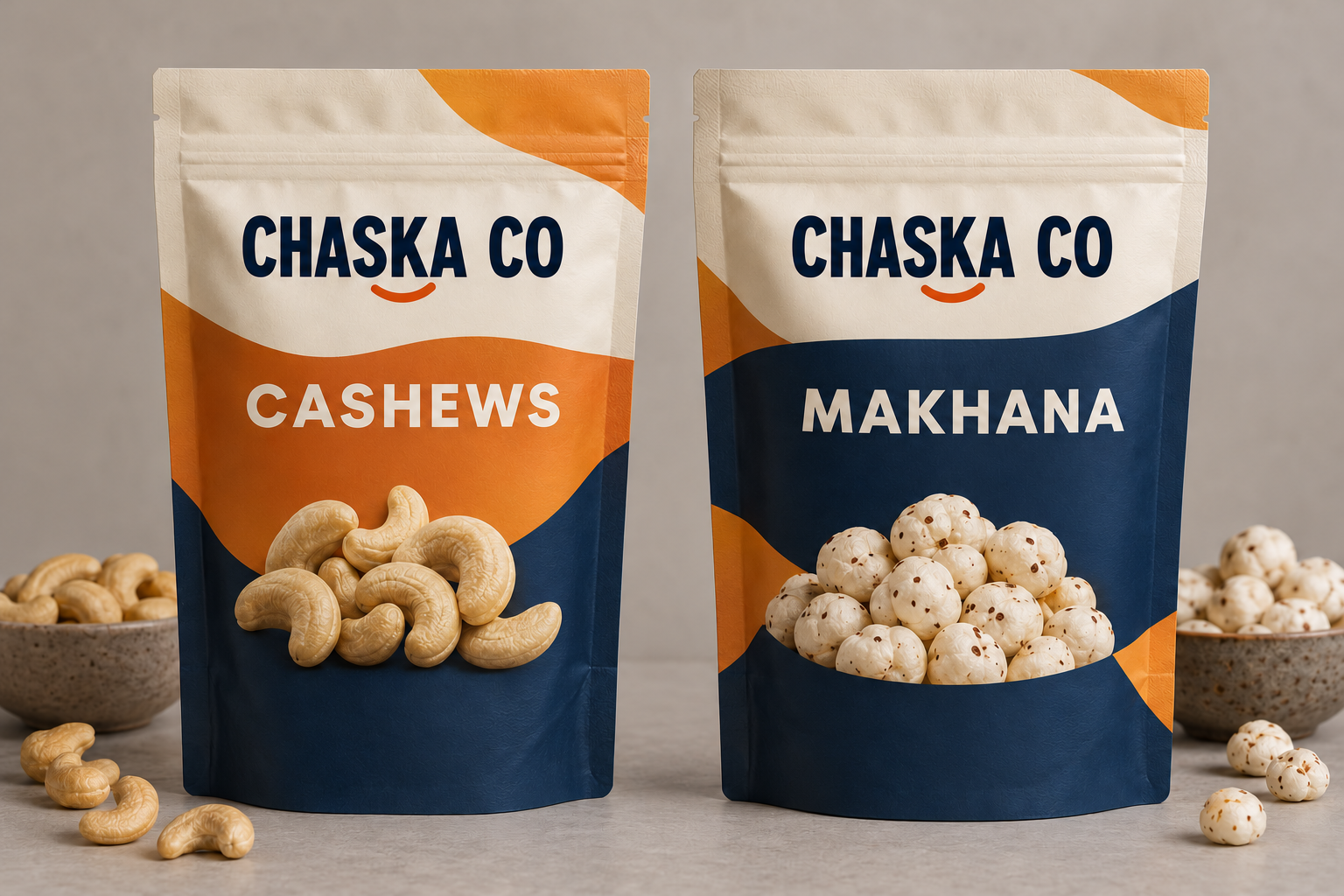
Relevant Kraftix Digital specifications
The printed-pouch order form starts at 500 pieces. It lists four sizes, matte finish, zip lock, tear notch and a BOPP + MetPET + Poly construction.
Price example checked on 13 October 2026: 500 printed pouches, 4.3 × 6.7 × 2.75 inches (XS), default matte configuration — ₹13,688 including GST (₹27.38 per pouch, rounded). This is an observed calculator configuration, not a universal price or a locked quotation.
Do not describe this printed offer as a sub-500-piece order. The header says 10–15 days while the printing-time panel says 7–10 business days: get a written dispatch estimate after proof approval. Nominal size does not prove fill capacity or product compatibility.
Source: Printed stand-up pouches — current specifications and options (checked 13 October 2026). Check the chosen configuration before ordering.
- Compare standup pouch packaging cost using the complete order total, not an isolated pouch rate.
- Stock pouches with packaging stickers separate pouch purchasing from branding; account for label application.
- Direct-printed pouches combine packaging and branding; check artwork requirements and minimum quantities before ordering.
Why this matters
For a small food, beauty or fashion brand, packaging is an order decision before it is a design decision. A pouch that looks suitable in a photograph still needs to fit your product, close correctly and carry readable information. Buying the wrong specification creates a problem that a lower quoted rate does not solve.
How much does standup pouch packaging cost for small batches?
The useful answer is the total payable for your specified batch, divided by the number of usable, finished pouches. A quote for plain pouches and a quote for printed pouches are not equivalent unless both include everything needed to prepare them for filling.
Use this calculation when comparing standup pouch packaging cost:
Finished packaging cost per pouch = total packaging order cost ÷ usable finished pouches.
Keep product filling costs separate unless every supplier includes them on the same basis. Otherwise, you are comparing different services rather than different packaging costs.
What belongs in the cost breakdown?
Ask for an itemised quote that distinguishes included work from separately charged work. Do not assume a charge applies; ask whether it does.
| Quote component | What to confirm | Why it matters |
|---|---|---|
| Pouch supply | Material structure, dimensions, finish and quantity | Establishes what you are buying |
| Branding | Direct printing, separate labels or no printing | Defines how the pouch becomes retail-ready |
| Artwork preparation | File requirements and any preparation charges | Prevents a design task from appearing after approval |
| Print setup | Whether setup is included or separate | Makes different printing quotes comparable |
| Label application | Who applies labels and whether that work is included | Accounts for the work between delivery and filling |
| Closure and sealing | Included features and required sealing equipment | Checks whether the pouch fits your packing process |
| Delivery and taxes | What the final payable amount includes | Avoids comparing a partial quote with a complete quote |
Save the specification beside the quote. An itemised total without a matching material, size and closure description still leaves too much room for misunderstanding.
Stock pouches with labels: best for keeping branding separate
Stock pouches with separately printed labels let you make the pouch and artwork decisions independently. That approach is useful when you want to assess an existing pouch format before committing to printed packaging. Confirm the actual pouch quantity and label quantity available for your order.
For separately labelled pouches, compare the sheet-versus-roll label cost guide using a consistent count of usable labels and the same material specification.
The trade-off is application work. You need somewhere suitable to place the label, an adhesive that suits the pouch surface and a repeatable way to align it. A label that crosses a crease or interferes with the closure creates a practical problem even when the artwork is correct.
Best for: small brands that want to change label artwork without changing the pouch specification.
Main limitation: separate purchasing and application introduce tasks that must be included in your order plan.
For a bakery or dry-food business, check the label against the filled pouch rather than an empty sample. For beauty products, assess the expected contact with moisture or product residue before choosing the label material. Neither a paper appearance nor a glossy finish establishes suitability on its own.
Direct-printed pouches: best for integrated branding
Direct-printed pouches put the artwork on the packaging rather than on a separate label. This removes the separate label-application step for that artwork. It does not remove the need to check print placement, material suitability or sealing requirements.
Before ordering, confirm which printing process the supplier proposes, what artwork files it accepts and how it handles different product variants. Ask whether each design has its own quantity requirement. A combined order total does not automatically mean you can divide it freely across different designs.
Best for: brands with settled artwork that want the packaging and branding supplied together.
Main limitation: design changes become changes to the printed pouch order, not just to a separate label.
For a food brand with several flavours, write down the quantity required for each artwork version. For a cosmetics brand, separate any shared design elements from product-specific information. This gives the supplier a clear brief without assuming that every variant follows the same ordering terms.
Plain pouches: best when branding is handled elsewhere
Plain pouches keep printed artwork out of the pouch purchase. They suit situations where your branding or required information is supplied through another confirmed method. They are not automatically a complete retail-packaging solution.
Best for: businesses whose packaging plan already accounts for product identification separately.
Main limitation: a plain pouch still needs whatever product information your use case requires. Do not remove that work from the comparison simply because it is absent from the pouch quote.
| Packaging route | Best for | Practical advantage | Practical limitation |
|---|---|---|---|
| Stock pouch with label | Separate pouch and artwork decisions | Branding can be ordered independently | Labels need suitable materials and application |
| Direct-printed pouch | Settled designs supplied as finished packaging | No separate label application for printed artwork | Artwork changes affect the pouch order |
| Plain pouch | Branding handled by another confirmed method | Pouch purchasing stays separate from printing | Product identification still needs a plan |
There is no universal cheapest route. The right comparison includes the work needed to reach the same finished result, not just the items listed on a supplier's invoice.
Why standup pouch packaging cost varies
Your quote should identify the specification behind the total. These factors define what the supplier is being asked to provide:
- Order quantity: request the total and quantity together, including how the order is split across designs.
- Material structure: specify the packaged product and storage conditions; ask the supplier to explain the proposed construction.
- Pouch dimensions: confirm width, height and gusset rather than relying on a capacity description alone.
- Printing scope: identify the artwork versions, printed areas and proposed printing process.
- Closure and finish: state whether you need a zipper, tear feature or particular surface finish, and confirm what is included.
- Preparation and delivery: establish responsibility for artwork preparation, label application, packing and delivery.
Treat these as comparison fields, not reasons to accept an unexplained increase. If totals differ, ask which specification or included service differs. A higher total is not evidence of better packaging, and a lower total is not evidence of equivalent packaging.
How do I request a comparable small-batch pouch quote?
A useful quotation request describes what you will pack and how you will pack it. Send the same brief to each supplier so that the replies answer the same purchasing question.
- Product use: describe the product, its physical form and the expected storage conditions. Ask for suitability confirmation for that use.
- Pouch size: provide the intended dimensions or request a sample to assess fit. Check the pouch with the actual product before approving a batch.
- Material choice: request the proposed material structure and the reason it suits your requirements. Keep that description with the quotation.
- Artwork check: identify each design version and the information that changes between versions. Confirm file requirements and the approval process before printing.
- Complete quote: request the total payable, included services, quantity and delivery terms. Clarify any exclusions before placing the order.
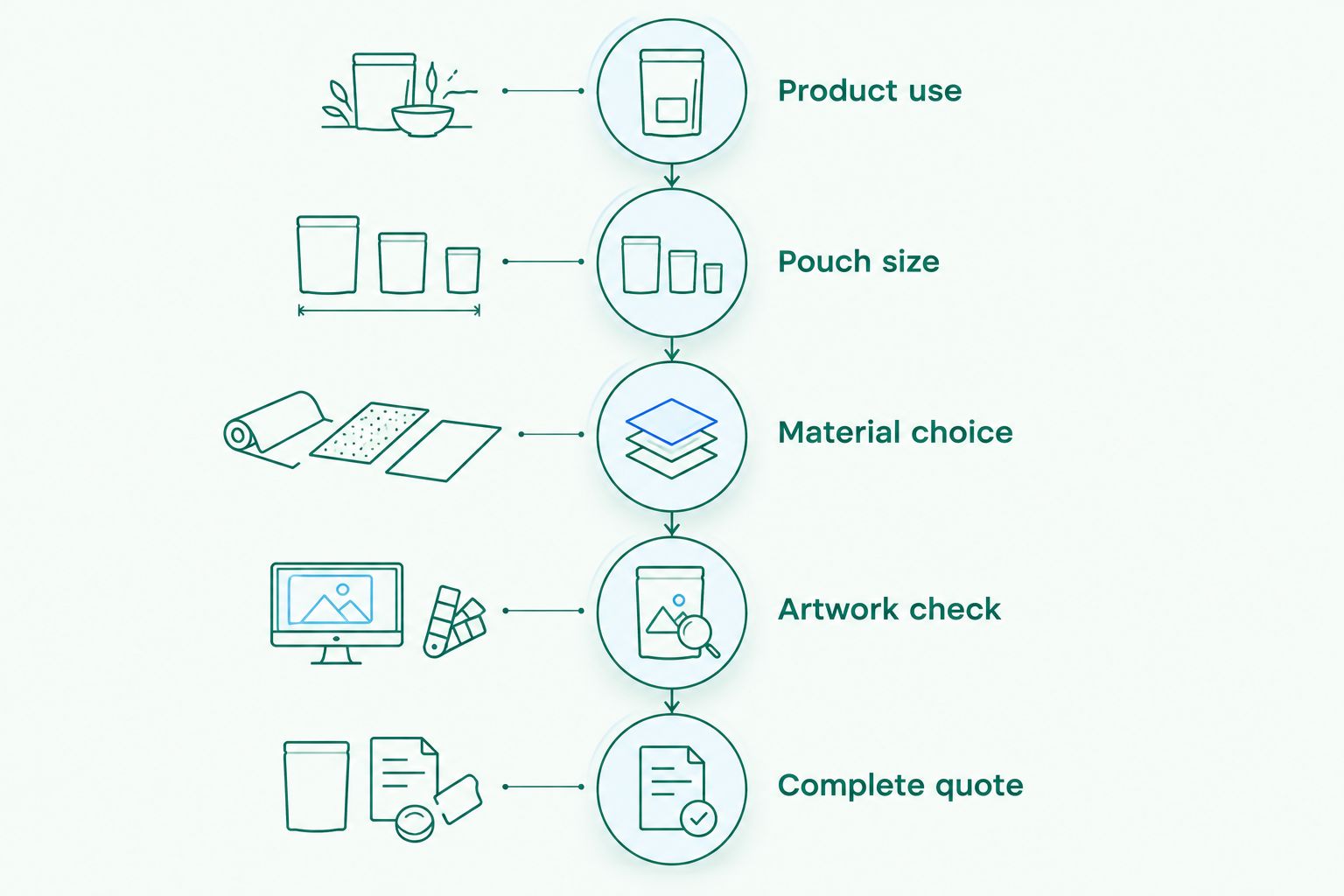
Keep the approved brief available for reordering. Record the specification, artwork version and supplier confirmation—not just a photograph of the pouch. A photograph cannot establish the construction or the terms of a previous order.
What should I check before approving a pouch sample?
Test the pouch as packaging, not as an empty display item. Put the intended product inside, check how the pouch stands and confirm that the usable area supports your label or printed information.
For food and beverage products, request documentation relevant to the intended product contact and use. Do not treat a packaging photograph or a general description as evidence that a pouch is suitable for a particular food. For skincare and cosmetics, ask about compatibility with the actual contents rather than approving on appearance.
For Indian food applications, consult FSSAI’s official packaging regulations, compendia and amendments and obtain documentation for your intended product and packaging. This guide does not certify a pouch or approve a food-contact use.
Check these details before accepting the sample:
- The intended fill fits without interfering with the closure or sealing area.
- The pouch stands in the way your display or packing process requires.
- The branding remains readable when the pouch is filled.
- A separate label lies properly on its intended application area.
- The closure works with your filling and sealing process.
- The sample specification matches the specification on the quote.
Approve the material and artwork separately where the supplier's process allows it. A correct logo does not establish a correct pouch, and a suitable pouch does not establish correct product information.
Are stock pouches with labels cheaper than printed pouches?
Stock pouches with labels are not automatically cheaper than printed pouches. Compare the complete cost of both routes at your required quantity, including label printing and application where relevant.
For your order, ask each supplier to quote the same finished requirement. If you will apply labels yourself, account for that work in your decision rather than treating it as absent. Choose stock pouches for the separation between packaging and artwork—not on an unsupported assumption about savings.
Does ordering more always reduce packaging cost?
A larger order is only better value if the extra packaging is useful to your business. Ask for written totals at the quantities you are considering, then compare both the per-pouch figure and the amount you must commit.
Consider whether the product name, ingredients, variant information or design is settled before increasing the batch. Packaging you cannot use does not become good value because the quoted unit figure is lower. Order against a real requirement, not just a more attractive quotation tier.
Can I use waterproof stickers on standup pouches?
Waterproof stickers still need to suit the pouch surface and expected handling. Resistance to water does not by itself establish adhesion, suitability for product contact or compatibility with the packaged contents.
Ask for confirmation of the sticker material, adhesive and intended application. Then test the label on the actual pouch. For a refrigerated beverage or bathroom product, describe the expected moisture exposure rather than asking only for a waterproof finish.
FAQ
How do I calculate standup pouch packaging cost for a small batch?
Divide the complete packaging order cost by the number of usable finished pouches. Include separate printing, preparation, application and delivery charges where they apply, and compare matching specifications.
What's the best pouch option for a small Indian brand?
The best option is the one that suits your product, quantity and packing process. Stock pouches with labels separate branding from pouch supply, while direct-printed pouches supply the artwork on the packaging.
Is a plain pouch quote comparable with a printed pouch quote?
A plain pouch quote is comparable only after you account for the branding and preparation needed to reach the same finished result. Check dimensions, construction, closure and quantity as well.
Can I divide a small pouch order between different designs?
Confirm design-wise quantities with the supplier before ordering. A total batch quantity does not establish the minimum quantity for each artwork version.
Should I choose pouch size by the product's weight?
Do not choose pouch size by weight alone. Check the actual product fit, pouch dimensions, gusset and space needed for closure or sealing.
Does Kraftix Digital offer printing for small businesses?
The printed-pouch order form starts at 500 pieces. It lists four sizes, matte finish, zip lock, tear notch and a BOPP + MetPET + Poly construction.
What should I confirm before reordering pouches?
Confirm the material specification, dimensions, closure and approved artwork before reordering. Also check the current quantity requirements and order terms rather than assuming they match an earlier purchase.
Before you approve production
Write the pouch dimensions and material specification beside the approved artwork file. That simple record separates what the package looks like from what it is made to do. When you reorder, you can check both instead of approving a familiar-looking design on a different pouch.
For your next batch, make the decision in this order: suitable packaging, correct artwork, complete quotation. Do not let a low headline rate reverse that sequence.