Product label printing cost in India: sheets vs rolls
Kraftix Digital’s current product-label form supplies labels in sheets, not rolls. On 13 October 2026, 25 round 2 × 2-inch labels in the displayed Standard–Economical configuration cost ₹332.25 including GST—₹13.29 per label. A roll quote needs a separately confirmed label count, material and machine-compatible roll specification; the sheet price is not a per-roll rate.
Relevant Kraftix Digital specifications
The live order form offers 17 preset sizes plus custom sizing, multiple materials and a minimum of 25 labels. Its displayed supply format is sheets, not rolls.
Price example checked on 13 October 2026: 25 round labels, 2 × 2 inches, Basic printing, Standard–Economical material, supplied in sheets — ₹332.25 including GST (₹13.29 per label). This is an observed calculator configuration, not a universal price or a locked quotation.
This is a sheet-label configuration, not a roll-label price. Recalculate after selecting the required material, size and quantity. Optional design enhancement and delivery can change the payable total.
Source: Custom product labels — current specifications and options (checked 13 October 2026). Check the chosen configuration before ordering.
- Compare product label printing cost per roll using identical specifications and the same labels-per-roll count.
- For custom label printing, choose material and adhesive around the container and its exposure.
- Compare product label printing quotes using usable labels, not roll totals alone.
Why this matters
A cheaper roll is not necessarily a cheaper order. If quotes cover different label counts, sizes or finishes, the totals answer different questions. Your first job is to make the specifications match.
For a skincare bottle, bakery box or clothing package, the useful question is straightforward: what will you pay for labels that fit, stay attached and carry readable information?
How much does product label printing cost per roll in India?
There is no single per-roll figure that describes every product label order. A meaningful quote needs a defined label count and specification, rather than just the word roll.
Use this sequence to build a comparable quote:
- Define the label. Give the finished width and height in millimetres, the shape and the intended container.
- Define the count. State the total labels required, the labels per roll and the number of separate designs.
- Define the construction. Specify the face material, adhesive and any protective finish you need.
- Define the supply format. Confirm rolls rather than sheets or loose labels. Include application-equipment requirements where relevant.
- Check the total. Ask which preparation, production, tax and delivery charges the quotation includes.
- Compare usable labels. Divide the comparable order total by the number of labels you can actually apply.
These steps prevent a common purchasing error: comparing a small roll of large labels with a larger roll of smaller labels. They also expose differences hidden behind broad descriptions such as premium labels or waterproof stickers.
A clear quote states what is supplied. If an important specification remains unclear, resolve it before approval rather than assuming the lower total includes it.
Paper, film and clear labels: what should your quote specify?
Choose a construction for the product's use, not simply its appearance. Paper describes a face material, film describes another material family, and clear describes an appearance that still needs a defined material and adhesive.
The options below are general buying categories, not a statement of any supplier's current catalogue.
| Option | Best for | Practical advantage | Limitation to check |
|---|---|---|---|
| Paper labels | Dry cartons, bakery boxes and clothing packaging | Suitable for printed information on dry packaging | Do not assume resistance to condensation, grease or repeated wiping |
| Film labels | Containers exposed to moisture or handling | A useful category to investigate for moisture-exposed products | Film alone does not establish ink, adhesive or finished-label performance |
| Clear labels | Packaging where the container should remain visible | Leaves unprinted areas visually open | Text contrast and white-ink requirements need checking on the actual container |
Do not approve a material based only on the word waterproof. Ask what the finished label is intended to withstand: splashes, condensation, wiping or another specific exposure. Those are different requirements.
A perfume bottle, refrigerated beverage bottle and dry fashion mailer need different checks. Describe the real conditions to the printer rather than choosing a material name first and hoping it fits.
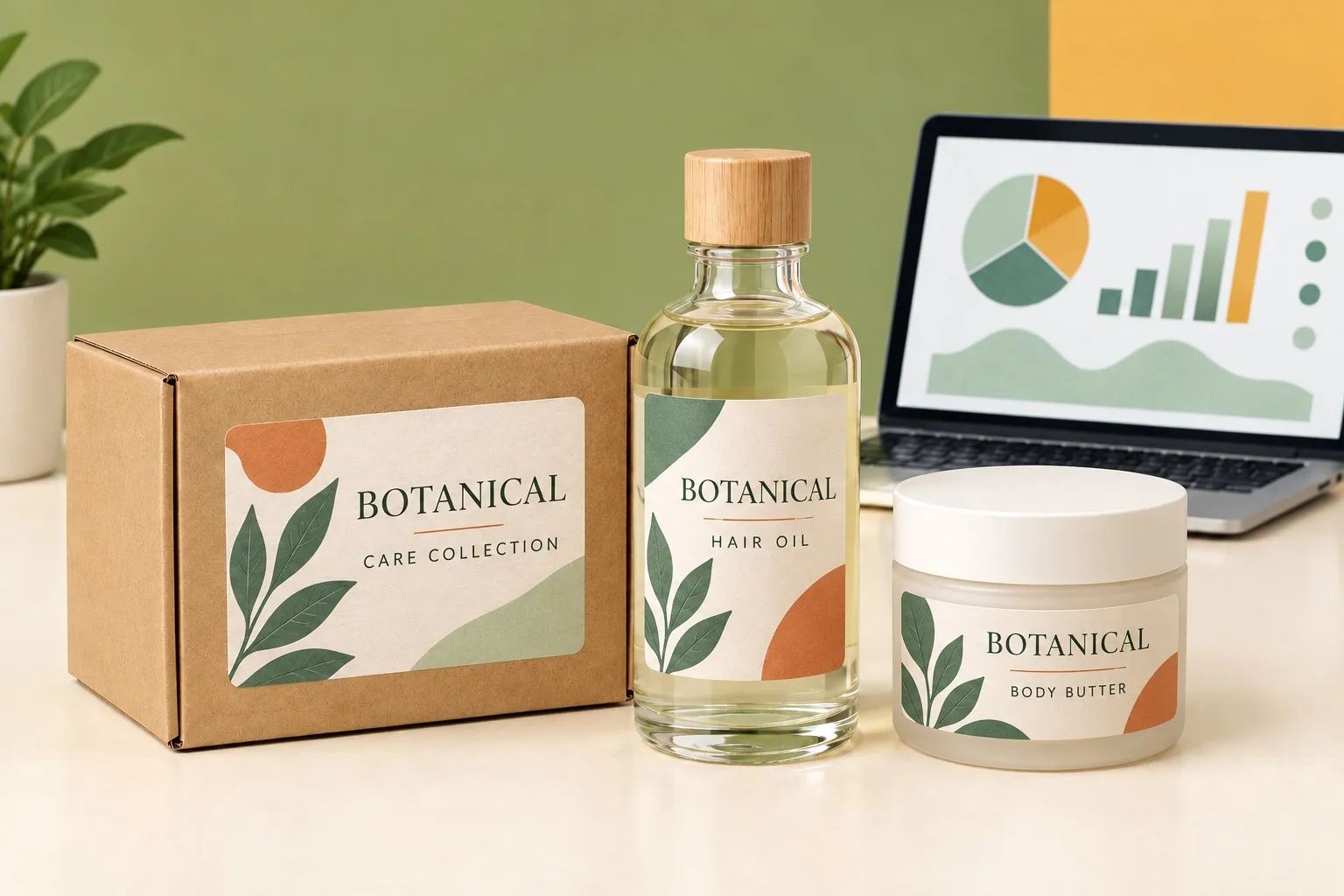
A finish is a separate specification. If you request matte or gloss, confirm how the printer produces it and whether it changes the label's protection, appearance or suitability for later writing or coding.
Why product label printing cost per roll varies
For a comparison, keep these factors consistent across quotations. Changing any of them changes what you are buying, even when the supplier still calls the order a roll of labels.
- Label dimensions and shape: Finished width, height and cut shape define the physical label. Compare the same dimensions rather than similar-looking designs.
- Material and adhesive: Specify both the printed face material and the adhesive's intended surface and exposure. A material name alone leaves part of the construction undefined.
- Printed coverage and finish: Identify colour printing, clear areas, white ink where needed, and any requested coating or decorative treatment. Ask which elements are included.
- Total quantity and design split: State the total labels and the quantity for each artwork version. One design and several product variants are different production briefs.
- Roll and application requirements: Labels per roll, winding direction and application-equipment requirements determine whether the delivered format is usable.
- Included charges: Artwork work, setup, cutting, packing, taxes and delivery must be either included or clearly separated before comparing order totals.
Do not assume that changing one factor produces a predictable saving. Ask for a revised quote with that change isolated. That gives you a real purchasing choice instead of a guess about how printing is priced.
How do you compare roll-label quotes fairly?
Compare like-for-like totals first, then calculate the cost per usable label. Keep the label count, artwork versions, material, adhesive and finish identical across the quotes you are assessing.
| Quote detail | What to record | Why it matters |
|---|---|---|
| Finished size | Width and height in millimetres | Establishes the actual label being supplied |
| Label quantity | Total labels and labels per roll | Makes the roll total interpretable |
| Artwork versions | Quantity for each design | Prevents different variant splits from being treated as equivalent |
| Construction | Material, adhesive and finish | Identifies differences hidden by broad product descriptions |
| Supply format | Roll specifications and winding | Checks compatibility with your application method |
| Order total | Included charges and separate charges | Gives you a comparable purchase total |
The calculation is simple: comparable order total ÷ usable label quantity = cost per usable label. Keep the tax treatment consistent when comparing suppliers or revised specifications.
Also distinguish label quantity from pack quantity. A front label and a back label are separate pieces; a roll count does not automatically tell you how many finished products you can label.
For your order, retain the specification beside the quotation. A saved total without its size, material and quantity is a poor reference for the next purchase.
What should you include in a roll-label enquiry?
Send one written brief that connects the artwork to the physical package. This avoids discussing appearance in one message, quantity in another and adhesive only after approval.
Container details
Name the container material and describe the application area. Mention whether it is flat, curved, textured or tapered, and whether labels will meet water, oil, refrigeration or regular handling.
For skincare, describe both the bottle or jar and the expected exposure during use. For bakery packaging, distinguish a label on the outer box from one intended to contact food directly. Do not assume a general packaging label is approved for direct food contact. Review the FSSAI packaging regulations and amendments for food-packaging requirements.
Artwork details
State the finished dimensions, shape, design versions and any variable information. Ask for the printer's file requirements before finalising the artwork, including bleed, safe margins and handling of small text.
Clear labels need special attention to contrast. A design that reads well against a white screen can become hard to read against a dark bottle or a coloured product inside transparent packaging.
Roll details
Say whether you will apply labels by hand or with equipment. For equipment application, obtain the machine's requirements and pass them to the printer rather than guessing the core, roll diameter or winding direction.
For hand application, ask how the labels will be presented and peeled. Confirm that the quoted supply format matches the way your team will use the labels.
Approval details
Ask what you will review before production and what that review covers. A digital artwork proof can help check content and layout; it does not establish how the adhesive performs on your container.
Confirm whether a physical sample or other suitability check is available for the specific order. Keep artwork approval and material suitability as separate decisions.
How do you check a label before approving the order?
Use your actual packaging, not a substitute container. The label needs to work on the surface you sell, under the conditions your customer creates.
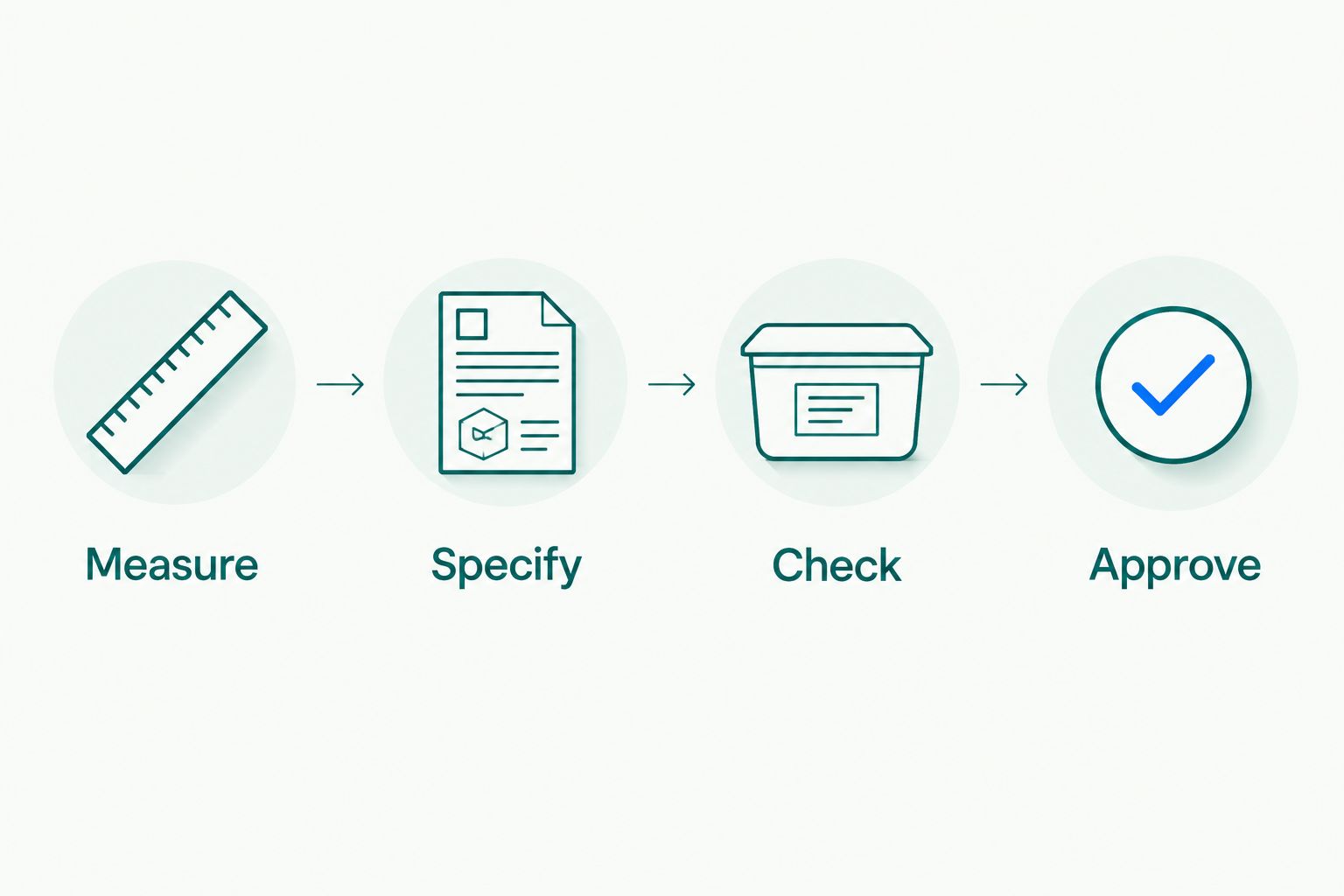
Follow this sequence:
- Measure: Check the available label area on the filled or assembled package. Avoid placing important text across a seam or sharp curve.
- Specify: Record the material, adhesive, finish, size and supply format in the quote brief.
- Check: Where a suitable sample is available, apply it to the real container and inspect adhesion, readability and handling.
- Approve: Check the final artwork against the agreed specification before authorising production.
The sample check should match the product's intended use. For a beverage container, inspect the label under the relevant moisture conditions; for a cosmetic jar, consider normal handling and contact with the product around the label area.
Document the accepted specification alongside the artwork file. When reordering, confirm that both remain unchanged; matching the design alone is not enough to define the same label.
Are roll labels better than sheet labels for small orders?
Roll labels and sheet labels are different supply formats, not automatic indicators of quality. Choose the format around application and the supplier's verified offer for your order.
| Format | Best for | Benefit | Trade-off |
|---|---|---|---|
| Roll labels | Equipment application or workflows designed around rolls | Presents labels in a continuous sequence | Requires compatible roll specifications where equipment is used |
| Sheet labels | Manual application organised around sheets | Allows a sheet-based peeling and sorting workflow | Does not suit equipment that requires rolls |
Do not request rolls solely because the product label printing cost per roll sounds like a standard purchasing measure. If you apply labels by hand, compare the actual workflow and total quote for the available formats.
Should you order more labels to reduce the unit cost?
Order more only after comparing a real revised quote and checking how many labels you can use. A lower quoted unit cost does not help if the extra labels become unusable after an artwork or packaging change.
For a purchase, separate stable artwork from details you expect to change. Product names, pack sizes, ingredients and required information all deserve checking before you commit to a larger run.
Ask how quantities are allocated across variants. A combined order total is not a substitute for knowing how many usable labels you receive for each product.
FAQ
How much does product label printing cost per roll in India?
Product label printing cost per roll depends on the label size, count, material, adhesive, finish and order quantity. Request a specification-based quote and compare the cost per usable label, including the same charges in each total.
What's the best way to compare label printing quotes?
The best comparison uses identical label specifications and quantities. Record the labels per roll, artwork versions, material, adhesive, finish and included charges before comparing totals.
Are waterproof labels always the right choice for cosmetic packaging?
Choose cosmetic labels for their actual exposure, not the waterproof description alone. Check the finished label's suitability for the container, moisture, product contact around the label area and normal handling.
Can I order product labels in low quantities?
The live order form offers 17 preset sizes plus custom sizing, multiple materials and a minimum of 25 labels. Its displayed supply format is sheets, not rolls.
Do roll labels work with every labelling machine?
Roll labels must match the labelling machine's requirements. Confirm the required core, roll dimensions, winding direction and label arrangement with the equipment documentation and printer.
Should I choose paper labels or film labels?
Choose paper or film according to the package surface and expected exposure. Paper is a category to consider for dry packaging; moisture-exposed products need a construction whose finished-label performance is confirmed.
Does a digital proof confirm that a label will stick properly?
A digital proof does not confirm adhesive performance on your container. Check artwork separately from physical suitability, using the actual packaging when a suitable sample is available.
Before you approve production
Check the back of the label specification as carefully as the printed front. Readable artwork cannot compensate for an adhesive or supply format that does not suit your packaging workflow.
For your next order, save one specification containing the approved artwork, finished size, construction, quantity and roll requirements. That is a useful reorder reference; the old invoice total alone is not.