Choosing thank you card styles for small business orders
A simple flat card is a practical starting point for everyday parcels. Reserve handwriting space for personalised orders, or combine useful care instructions with a short acknowledgement when the product needs them. This guide compares six thank you card printing styles for small Indian brands, from everyday parcel inserts to gift-ready folded cards.
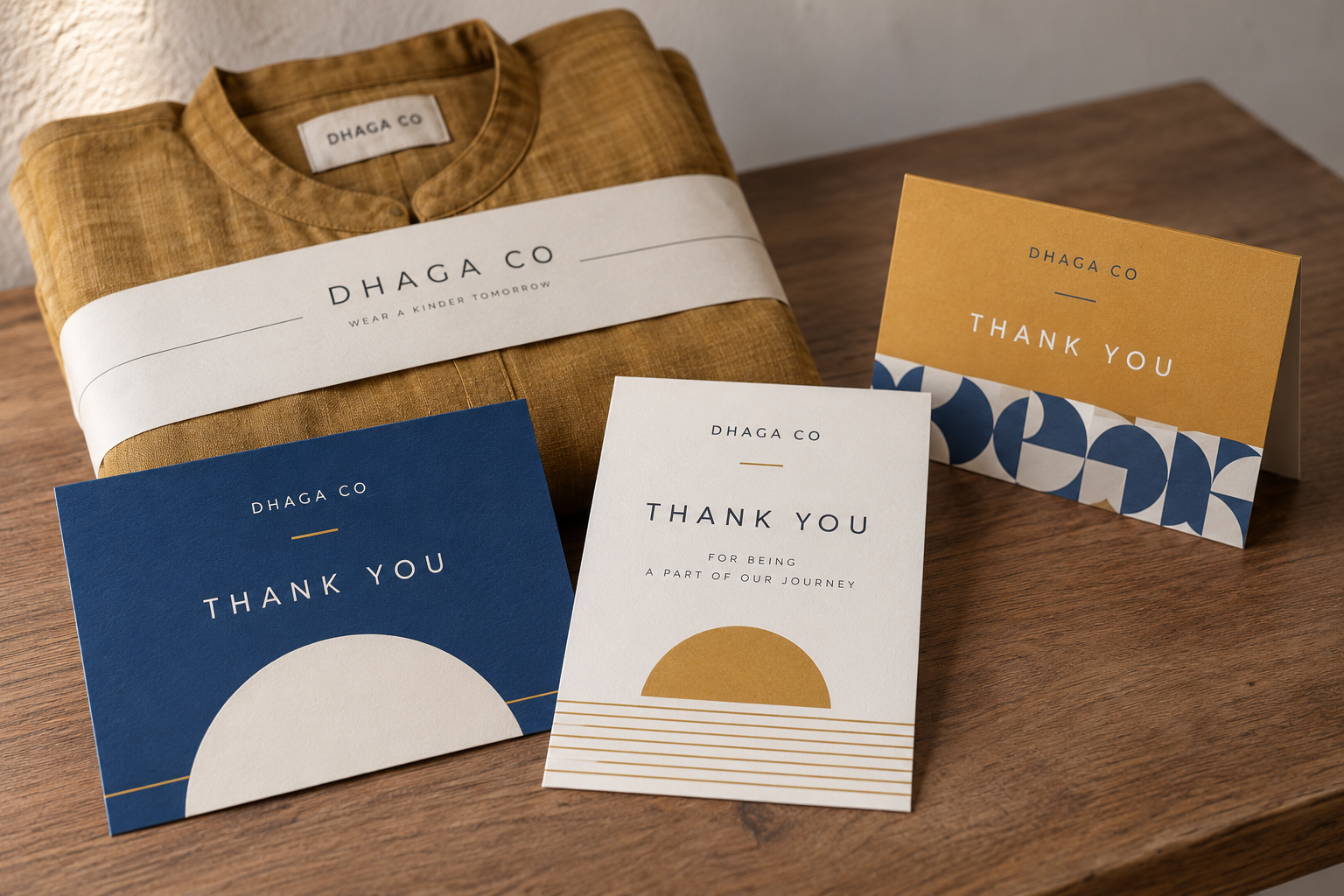
Relevant Kraftix Digital specifications
The premium thank-you-card order form starts at 25 cards. It offers 300 GSM ivory texture, 350 GSM velvet-touch matte and 400 GSM board with one-sided spot UV, with preset or custom sizes and straight or rounded corners.
Price example checked on 13 October 2026: 25 cards, 3.5 × 5 inches, 300 GSM ivory texture and straight corners showed ₹310.40 including GST (₹12.42 each, rounded). This is one observed configuration, not a fixed quotation for every style. Confirm any shipping or optional work in the final total.
The proof banner says 8 hours while the product description says 24–48 hours. Confirm the applicable proof and dispatch estimate before setting a launch deadline. Folded layouts and pen compatibility must be checked separately; the style names in this guide are design approaches, not a promise that every configuration is offered.
Gold and silver foil belong to the separate foil thank-you-card offer; do not apply its stock, finish or quantity choices to the non-foil form.
- Choose minimalist thank you card printing for everyday parcels; keep the message short and easy to read.
- Use handwritten-note cards for personalised orders and care-and-thanks cards for useful product instructions.
- Kraftix Digital serves small Indian brands ordering printed materials; check card-specific specifications before placing an order.
- Match packaging inserts to the parcel, required information and packing workflow, not decoration alone.
Why this matters
A thank you card takes space inside the parcel and time at the packing table. Give it a clear job: acknowledge the purchase, explain care, support a repeat order or introduce the maker. Trying to do everything on one small card creates competing messages.
For your packaging plan, start with the orders you actually send. A clothing parcel needs different instructions from a bakery box, and a gift recipient does not need the same message as the person who placed the order.
What makes the best thank you card style?
Judge thank you card printing against these criteria before choosing a design:
- Clear purpose: The reader understands why the card is included without searching through several messages.
- Parcel fit: The finished card sits flat inside the packaging without hiding essential product information.
- Readable content: The type remains legible at actual printed size, including care instructions and contact details.
- Suitable surface: A handwritten card needs a surface that works with your chosen pen; confirm this before ordering.
- Packing effort: The design fits your packing routine, including writing, folding or selecting different versions.
- Reusable wording: The message stays relevant across the products and orders that receive it.
For a first design, keep the brief narrow: 1 card per order, 1 main message and a clearly separated next step, if a next step is necessary. These are layout recommendations, not print specifications. Confirm finished dimensions, stock and finishing with the printer.
Thank you card styles at a glance
These are design approaches, not named products or confirmed print options. Use the table to choose a layout before requesting specifications.
| Style | Best for | Standout feature | Key limitation |
|---|---|---|---|
| Minimalist thank you card | Everyday orders across a mixed catalogue | Short message with little variable content | Limited room for detailed instructions |
| Handwritten-note card | Personalised or made-to-order purchases | Dedicated space for an individual message | Adds a writing step to packing |
| Care-and-thanks card | Products needing handling or care guidance | Practical instructions alongside thanks | Requires product-specific accuracy |
| Reorder-information card | Repeat-purchase products | Clear route back to the business | Printed destination needs maintenance |
| Maker-story card | Businesses with a relevant origin or process story | Explains who made the product and why | Story can crowd out the thank you |
| Folded gift card | Gift orders and presentation-led parcels | Separate cover and inside message | Folded format adds handling and bulk |
1. Minimalist card: best for everyday small-business orders
A minimalist thank you card puts a short acknowledgement at the centre of the design. Add your business name and, if useful, a single contact or reorder route. Keep product instructions elsewhere when they need more space.
This is the strongest default for a mixed catalogue because the wording does not depend on a particular item. A fashion business can use the same general acknowledgement across several clothing orders without printing a different message for every garment.
Minimalist card pros:
- Keeps the main message easy to find.
- Avoids unnecessary product-specific versions.
- Leaves room for readable type and clear spacing.
Minimalist card cons:
- Gives little space to detailed care guidance.
- Can feel generic when the wording says nothing beyond thanks.
Best for: Routine parcels containing different products from the same business.
Keep the message to 2 short sentences as a starting layout brief: one acknowledgement and one useful follow-up. Print a paper mock-up at actual size before approval; a spacious screen design can become cramped when reduced.
Verdict: Buy this style for your first general-purpose card. Change the wording only when another style solves a specific order requirement.
2. Handwritten-note card: best for personalised purchases
A handwritten-note card combines a printed message with a blank area for a name or individual note. The printed portion does the routine work. The writing area lets you acknowledge a detail that belongs to that order.
This suits customised clothing, selected gift sets or other purchases where the customer made a specific choice. Do not print a layout that leaves only a narrow strip for writing; handwriting needs usable space, not a decorative blank.
Handwritten-note card pros:
- Gives you room to acknowledge an individual order.
- Keeps repeated information preprinted.
- Allows wording to change without changing the artwork.
Handwritten-note card cons:
- Adds manual work to every order receiving a note.
- Requires a confirmed pen-compatible surface.
Best for: Personalised purchases where a specific message adds information or acknowledgement.
Test the intended pen on the chosen stock and finish. Let the writing dry, then handle the sample as you would during packing; check for smearing and transfer onto neighbouring packaging.
Reserve 1 writing area and keep printed decoration away from it. If writing becomes a packing bottleneck, retain this style for selected orders rather than forcing a handwritten message into every parcel.
Verdict: Buy for personalised orders; skip for a packing routine that cannot support handwriting.
3. Care-and-thanks card: best for product instructions
A care-and-thanks card places useful handling guidance beside a short acknowledgement. The instructions are the reason to keep the card. The thank you should remain visible without competing with information the customer needs.
For clothing, include care guidance that matches the actual garment. For skincare or perfume, use only instructions verified for the product; a decorative insert must not substitute for required product labelling. Food and bakery businesses should likewise keep essential information where applicable rules require it.
Care-and-thanks card pros:
- Answers a practical question after unboxing.
- Separates instructions from a longer promotional message.
- Gives the insert a purpose beyond decoration.
Care-and-thanks card cons:
- Needs accurate wording for each applicable product.
- Becomes confusing when unrelated instructions share one layout.
Best for: Products with a clear care, handling or storage instruction to communicate.
Keep the guidance specific. A statement that applies to one fabric, formulation or food item does not automatically apply to your whole catalogue. Separate versions when the instructions differ, and identify which product each card covers.
For an artwork revision, review the instructions against the current product rather than copying an old insert unchanged.
Verdict: Buy when verified instructions belong in the parcel; skip generic care claims.
4. Reorder-information card: best for repeat-purchase products
A reorder-information card thanks the buyer and gives a clear route back to your business. That route can be a readable website address or a QR code leading to a destination you control. Keep the destination relevant to the purchase.
For consumable products, the useful message is how to find the item again. Avoid turning the card into several competing requests for follows, reviews, referrals and repeat purchases.
Reorder-information card pros:
- Makes the intended next action explicit.
- Can keep the acknowledgement and follow-up together.
- Works without a discount-led message.
Reorder-information card cons:
- Loses usefulness when the destination changes or breaks.
- A QR-only design excludes readers who do not scan it.
Best for: Products customers need to find again after using them.
If you include a QR code, scan the printed proof rather than checking only the artwork on screen. Test the destination on a phone and include a readable alternative where the layout permits.
Keep a blank border around the code rather than crowding it with artwork. DENSO WAVE specifies a border four module-widths wide on each side in its QR Code quiet-zone guidance. Test your actual printed card; a correct border alone does not guarantee scanning.
A reorder card should not promise an offer, programme or service that your business does not provide. Keep the next step factual.
Verdict: Buy when you have a relevant, maintained reorder destination; skip unsupported incentives.
5. Maker-story card: best for explaining a meaningful process
A maker-story card pairs a thank you with a short explanation of the business or product-making process. Use facts that help the buyer understand the item: who makes it, which process matters or what prompted the business to start.
This style fits a clothing or food business with a relevant story to tell. The card does not need a founder biography; it needs a detail connected to what the customer bought.
Maker-story card pros:
- Adds context that product packaging might not explain.
- Gives a consistent introduction across suitable orders.
- Leaves room for a focused acknowledgement and business detail.
Maker-story card cons:
- Can become a dense block of text.
- Requires evidence for origin, process and sustainability claims.
Best for: Businesses with a specific, verifiable story that helps explain the product.
Choose one detail, then connect it to the purchase. Remove broad claims such as handmade, locally sourced or recyclable unless they accurately describe the relevant product or packaging.
Read the draft aloud. If the story needs several explanations to make sense, shorten it or move the longer version elsewhere.
Verdict: Buy when the story explains the product; skip when it is only promotional filler.
6. Folded card: best for gift orders
A folded thank you card separates a cover from an inside message. That gives the design distinct spaces for acknowledgement and a gift note. Confirm how the folded card fits inside the packed order, not just how the front looks.
For a perfume gift or clothing gift box, distinguish the purchaser from the recipient. A message thanking someone for placing an order can be wrong when the person opening the parcel received it as a gift.
Folded card pros:
- Separates the cover and inside content.
- Provides space for a gift message.
- Supports a different layout for gift orders.
Folded card cons:
- Adds a folding or placement step to packing.
- Occupies more space than an equivalent flat insert.
Best for: Gift orders needing a separate recipient-facing message.
Check the fold, orientation and inside text on a physical mock-up. Ask whether folding is included in the selected print specification; do not assume that a folded design arrives ready to pack.
Verdict: Buy for a defined gifting workflow; skip for ordinary parcels needing only a short thanks.
If your parcels also use sticker seals, use the sticker-sheet quantity guide to plan that order separately. A card count and a finished-sticker count are different quantities.
How to prepare your print brief
Before ordering thank you card printing from Kraftix Digital, write down the purpose, finished size, content, quantity and required finish. Check card-specific ordering details separately from the shop's broader low-quantity positioning.
Use this sequence to reduce avoidable artwork changes:
- Choose purpose: Select the style that solves the main communication need.
- Measure packaging: Check the usable space inside the actual packed parcel.
- Confirm material: Ask about stock, finish and handwriting suitability where relevant.
- Check proof: Review wording, orientation, printed size and any scan destination.
- Pack sample: Place a mock-up with the product and check the complete opening experience.
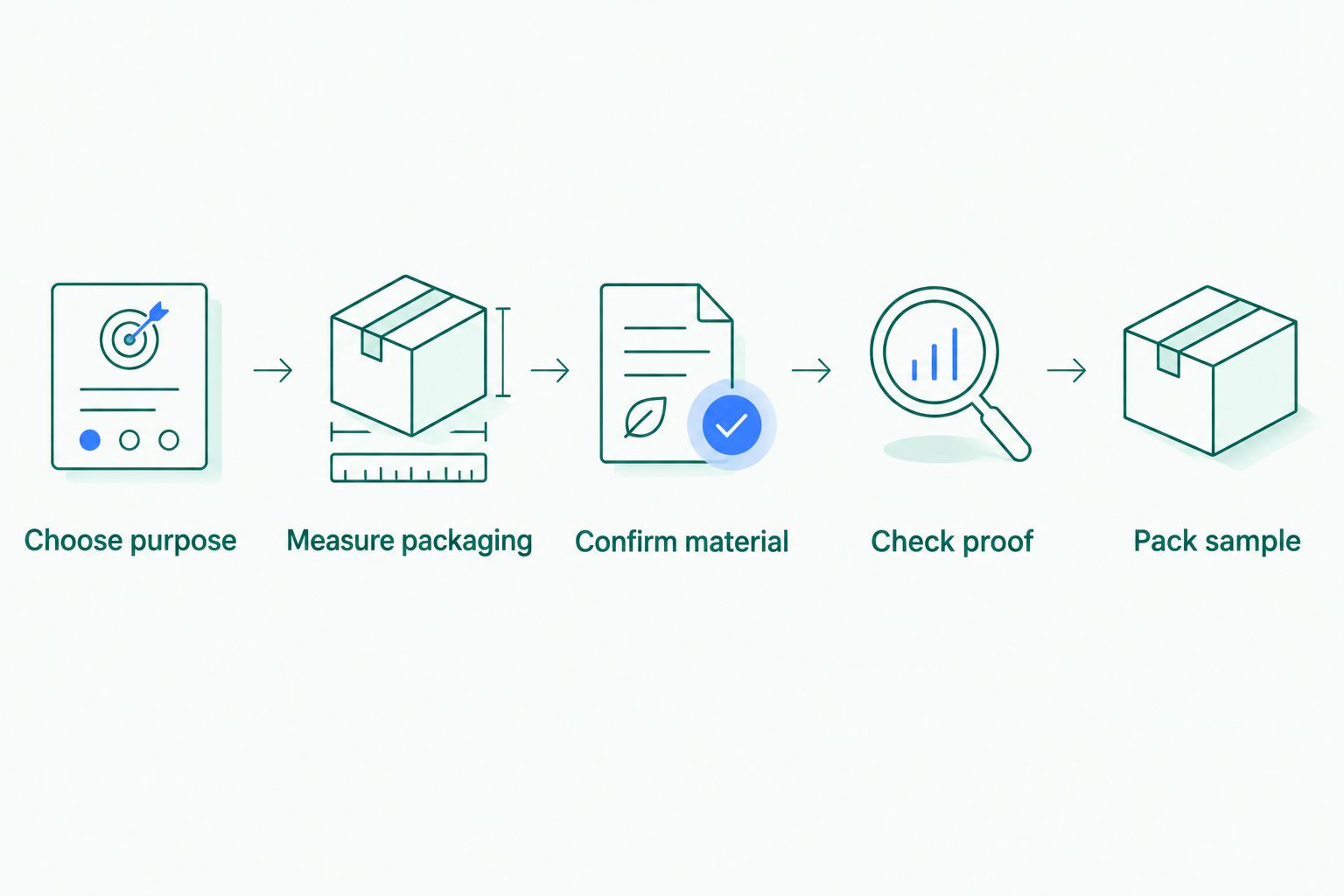
Use 3 proof checks before approval: content accuracy, physical fit and functional details. Functional details include handwriting space, fold placement or QR scanning, depending on the style.
Keep the approved artwork and specification together for reordering. If you change products, instructions or destinations, review the card again instead of treating the old file as permanently correct.
How we ranked these styles
The order prioritises clear purpose, parcel fit, readability and manageable packing effort. The minimalist card ranks first because it has fewer variable elements; the other styles earn their place by solving a more specific need.
This is a layout comparison, not a claim that particular materials or finishes have been tested. Your final choice still depends on the confirmed print specification and the sample inside your packaging.
Which thank you card style should you choose?
Choose a minimalist card unless your order needs personalisation, care guidance or a gift message. Add complexity only when it improves the information the customer receives.
FAQ
What's the best thank you card style for a small business?
A minimalist thank you card is the best default for everyday orders across a mixed catalogue. Choose a different style when the parcel needs personalised wording, product instructions or a gift message.
Is a handwritten thank you card better than a printed card?
A handwritten-note card is better for an individual message, while a fully printed card avoids a writing step. Confirm that the chosen stock and finish work with your pen before ordering.
What should I include in thank you card printing?
Include a clear acknowledgement, your business name and only the information needed for the card's purpose. Separate care guidance, a reorder instruction or a gift message so it does not compete with the main text.
What size should a thank you card be for packaging?
Choose a finished size that fits the usable space inside your packed parcel. Check an actual-size mock-up with the product before confirming dimensions with the printer.
How much does thank you card printing cost?
Confirm the current quote for your chosen size, stock, quantity and finish. Compare quotations using the same specification, including any folding or other finishing requirements.
Can a thank you card replace a product label?
Do not treat a thank you card as a replacement for required product labelling. Check the applicable requirements for your product and use the insert for supplementary information.
Should I add a QR code to a thank you card?
Add a QR code when it leads to a useful, maintained destination. Scan the printed proof and provide a readable alternative where space permits.
What should I confirm before ordering from Kraftix Digital?
Confirm the card-specific size, material, quantity, finish and artwork requirements before ordering. Ask about proof approval and any folding or handwriting requirements rather than assuming they are included.
Before you approve production
Pack the card in a complete sample order and open it as the customer would. A readable design can still fail when the message faces away, disappears beneath the product or addresses the purchaser instead of the gift recipient. Approve the packed result, not just the artwork.
Non-foil thank-you card options for order inserts
Kraftix Digital’s premium thank-you-card form starts at 25 cards, with 300 GSM ivory texture, 350 GSM velvet-touch matte and 400 GSM board with one-sided spot UV. Gold or silver foil is a separate foil thank-you-card offer; do not apply its quantity or finish choices to every card style.
On 13 October 2026, 25 cards at 3.5 × 5 inches, 300 GSM ivory texture and straight corners showed ₹310.40 including GST (₹12.42 each, rounded). Choose the insert size around the actual mailer or shopping bag. Keep the customer message readable; a heavier or more reflective stock is not proof of better customer response.